
No-Code Game Maker Techniques for Creating Better Levels
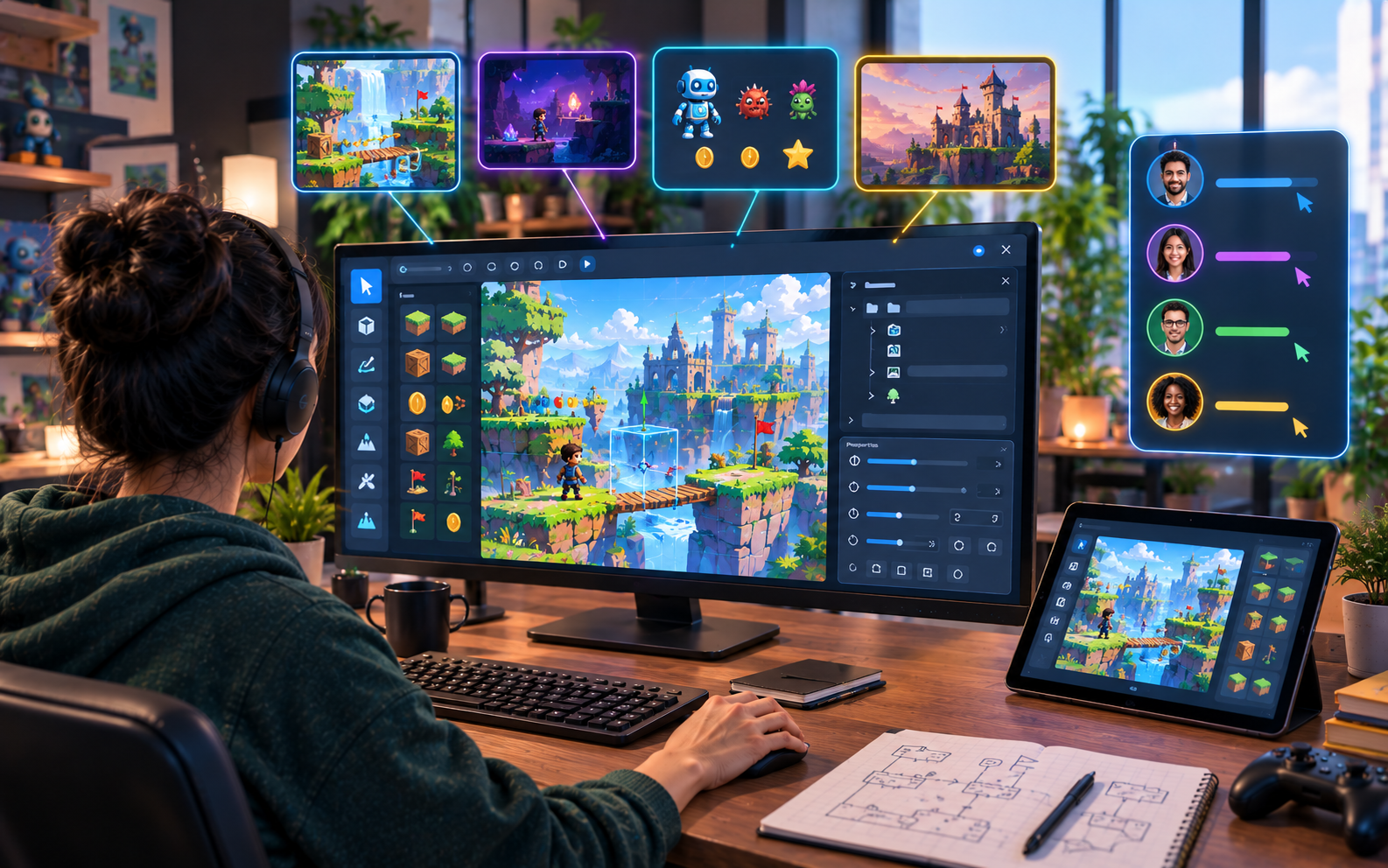
Level design is where game design becomes tangible. The mechanics matter, but what players actually experience is navigating through carefully constructed spaces, overcoming obstacles you designed, discovering secrets you planted, progressing through challenges that escalate in meaningful ways. Yet level design is often treated as an afterthought, something that happens after core mechanics are locked. No-code game maker tools are changing this by making level creation integrated into development rather than separate from it, letting creators iterate on level design simultaneously with mechanics rather than building levels once everything else is finished. That integration transforms level design from a final phase into continuous refinement, where testing reveals problems early and iteration happens throughout development rather than discovering issues too late to fix them meaningfully.
What Makes Levels Actually Work
A good level communicates clearly what a player should do. It introduces challenges gradually, building understanding before demanding mastery. It rewards exploration and curiosity. It feels intentional, like each element serves a purpose rather than being arbitrarily placed. Those qualities don’t emerge accidentally, they require deliberate design choices, extensive testing, and willingness to adjust based on how real players actually navigate spaces.
Poor level design creates confusion, where players don’t understand what they’re supposed to do. It spikes difficulty suddenly without warning. It punishes exploration and experimentation. It feels arbitrary, like challenges exist just to be difficult rather than serving larger design purposes. Those problems usually come from designing in isolation, assuming how players will interact rather than testing with real people.
How No-Code Tools Simplify Level Creation
Making Iteration Instantaneous
Traditional level design meant building a level, testing it, finding problems, returning to the editor, rebuilding, testing again. That cycle, repeated dozens of times, consumed enormous development time. Modern tools compress this cycle dramatically. Adjust a platform placement and see the result immediately. Change an enemy position and test the adjusted level within seconds. That instant feedback lets creators test far more variations in the time it used to take to test a single iteration.
That speed is genuinely transformative for level quality because you can afford to make many small adjustments, test each one, and keep improvements that work. Traditional development meant making fewer, larger changes and hoping they worked. Rapid iteration means making many small refinements that compound into genuinely better level design.
Supporting Collaborative Level Building
No-code tools make level building accessible enough that multiple people can contribute without requiring everyone to understand complex technical systems. A designer can layout a level while a technical person handles backend systems. A junior designer can build variations while a senior designer refines core structures. That collaborative approach distributes workload and brings diverse perspectives to design.
Providing Built-In Level Templates
Most no-code tools include templates and examples of level structures that work. A linear progression, a branching exploration level, a puzzle-focused space, templates for various level types let creators start with proven structures rather than building from scratch. Those templates aren’t limitations, they’re starting points. Creators can use templates as-is or customize them extensively to suit their vision.
Enabling Rapid Testing Without Rebuilding
Traditional development required rebuilding projects to test changes. No-code tools let you test a level immediately while editing it. That eliminates the friction between making a change and seeing results, making it practical to test dozens of small variations quickly.
Techniques For Better Level Design
Start With Clear Learning Progression
A good level teaches players what they need to know before requiring them to apply it. An action level might start with a simple platforming section that teaches basic movement, then add enemy patterns the player practices against safely before combining platforming and combat under pressure. A puzzle level might introduce individual mechanics separately, then require combining them.
That graduated progression lets players build competence gradually. A player understands fundamentals before facing challenges that depend on mastering them. That understanding creates confidence rather than frustration, which is the difference between engaging difficulty and overwhelming frustration.
Use Space To Guide Player Attention
Level layout naturally draws player attention. A path leading forward. A visible objective. A gap that’s slightly too wide for the current jump height but suggests what’s needed. Those spatial cues guide players toward intended progression without requiring explicit instruction. That guidance is most effective when it’s subtle enough to feel like discovery rather than explicit enough to feel patronizing.
Conversely, misleading spatial cues create confusion. A path that looks like it goes forward but actually leads nowhere frustrates players. A gap that looks impossible but is actually simple wastes time on confusion. Consistent spatial language, where layout reliably communicates what’s possible, creates the clarity that makes navigation feel intuitive.
Introduce Mechanics One At A Time
Adding too many new mechanics simultaneously overwhelms players. A single new mechanic per section, practiced until it’s intuitive, then combined with previously learned mechanics, creates manageable progression. A player feels like they understand what’s happening and can succeed through skill and understanding rather than luck.
That introduction also means the first encounter with a mechanic should be forgiving. A low-stakes introduction to a new mechanic teaches how it works. Later encounters increase pressure once the player understands fundamentals.
Create Vertical Variety Within Levels
A level that’s purely horizontal gets monotonous. Vertical variation, changing elevation, creating three-dimensional space, adds visual variety and gameplay variation. Different heights create different challenges. Looking down from high points rewards exploration. Climbing toward distant objectives creates progression. That vertical variety isn’t just aesthetic, it functionally makes levels more interesting.
Reward Curiosity and Exploration
The best levels encourage players to explore beyond the direct path. A secret alcove with rewards. A hidden path that shortcuts the main route. An area with no mechanical purpose but beautiful scenery. Those discovery moments create delight and make levels feel alive rather than purely linear.
That exploration should feel rewarding without being required. A player who ignores secrets should still progress normally. A player who explores should be rewarded for curiosity. That balance keeps discovery optional rather than mandatory, so players can choose their engagement level.
Testing Levels Effectively
Watch New Players Navigate Your Levels
The most valuable testing comes from watching someone unfamiliar with the level play through it without guidance. Note exactly where they hesitate, where they seem confused, where they lose interest. Those observations reveal far more than players’ verbal descriptions of their experience. A player might say a level is fine while their behavior shows they’re struggling.
Pay special attention to moments where a player’s behavior suggests they don’t understand something you assumed was clear. Those misunderstandings point directly to communication problems in your level design.
Test With Different Skill Levels
Different players navigate levels differently. An experienced player might breeze through sections that frustrate newcomers. A casual player might ignore challenges a hardcore player finds engaging. Testing with diverse skill levels reveals whether your level difficulty is appropriately tuned for your target audience.
Identify Consistent Quit Points
If multiple players stop or fail at the same location, that’s data suggesting a design problem. A specific difficulty spike where players consistently struggle. A confusing section where multiple people get lost. A mechanic that doesn’t feel intuitive. Those patterns reveal exactly where level design needs adjustment.
A Practical Example of Level Design Excellence
Escape the Tornado demonstrates what thoughtful level design produces, spaces that guide player progression naturally, introduce mechanics clearly, and escalate challenge meaningfully. The game shows how deliberate level design creates engaging experiences where players feel guided rather than confused.
Understanding how to use a game maker online to design better levels means integrating level testing into development, iterating based on observation, and treating level design as central to game quality rather than an afterthought.
Common Level Design Mistakes
A level that’s too linear leaves no room for player expression or exploration. A level introducing too many mechanics simultaneously overwhelms rather than teaches. A level that doesn’t clearly communicate what a player should do creates confusion instead of guidance. A level with difficulty that spikes suddenly frustrates rather than challenges meaningfully.
These mistakes are often caught during testing if you’re watching real players. That observation transforms potential problems into fixable design issues before release.
Why Level Design Deserves Attention
The best game mechanics only matter if they’re built into engaging levels. Conversely, average mechanics become engaging when built into thoughtfully designed levels. That emphasis means level design deserves as much attention as mechanics themselves, and modern tools make that attention practical by making iteration fast enough to refine levels thoroughly.
Final Thoughts
Visit this website: Tunegalote: What Does It Mean?
No-code game maker techniques for creating better levels mean starting with clear learning progression, using space to guide player attention naturally, introducing mechanics one at a time, creating vertical and visual variety, and rewarding curiosity and exploration. Test with real players representing different skill levels, watch exactly where they struggle or lose interest, and iterate based on observation. Design levels that teach through experience rather than instruction, that communicate clearly through spatial layout, that escalate challenge gradually as players grow more competent. The result is levels that feel intuitive to navigate, engaging to explore, and satisfying to overcome. Those well-designed levels transform average games into engaging experiences, and that transformation is increasingly achievable because modern tools make level iteration fast enough to refine extensively.